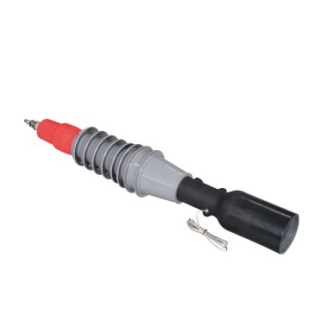
JY SYZD-35/630 Tapered casing test terminal of switch cabinet is a special test component designed specifically for the external conical bushing of 35kV/630A European-style switchgear. It is used for factory testing and on-site handover testing of switchgear to achieve a quick and safe connection between the external conical bushing and high-voltage testing equipment.
I. Product Overview
The JY SYZD-35/630 switchgear external conical bushing test terminal is a fully insulated, detachable test connection component designed specifically for 35kV European-style switchgear external conical bushings. It is integrally injection molded from EPDM rubber and has a built-in conductive connection structure. It can be directly installed on the external conical bushing of the switchgear, providing a safe and reliable connection channel for high-voltage tests such as power frequency withstand voltage and partial discharge. The test can be completed without the need for cable joints, greatly simplifying the test process and reducing test costs.
II. Core Features
1. Electrical and insulation properties
- Made of high-quality EPDM rubber through integral injection molding, it has excellent insulation properties and can withstand the test voltage of a 35kV system. Its power frequency withstand voltage and impact withstand voltage performance meet industry standards, providing reliable insulation protection for high-voltage tests.
- With a built-in semi-conductive shielding layer and uniform electric field distribution, the risk of partial discharge caused by electric field concentration during the test is eliminated, ensuring accurate and reliable test results.
- With a fully sealed structure and IP67 protection rating, it can effectively prevent moisture and dust from entering, avoiding insulation breakdown or test errors caused by environmental factors during the test.
2. Installation and testing compatibility characteristics
- It adopts a standard interface compatible with the external tapered bushing of 35kV European switchgear, which can be directly plugged in and unplugged for installation without the need for cable connectors or special tooling, making installation convenient and significantly shortening the test preparation time.
- It comes with high-voltage test connection terminals and can be directly connected to the high-voltage leads of the test equipment, and is suitable for various high-voltage test items such as power frequency withstand voltage, partial discharge, and DC withstand voltage.
- Modular design, reusable, eliminates the need for customized test fixtures for each switch cabinet, reducing test costs and improving test efficiency.
3. Safety and Environmental Characteristics
- With a fully insulated structure, the test terminal casing is grounded after installation, with no exposed live parts. No additional insulation protection is required during the test, ensuring the safety of test personnel.
- It has excellent weather resistance and can adapt to a wide temperature range of -40℃ to +90℃. The elasticity and insulation properties of the rubber do not decrease under high and low temperatures, making it suitable for various indoor and outdoor testing scenarios.
- It is resistant to aging, ultraviolet radiation, and ozone corrosion, has a long service life, and can be reused multiple times, reducing the investment cost of testing equipment.
III. Technical Parameters
| Parameter categories | project | Technical indicators |
| Electrical parameters | Applicable system voltage | 35kV AC |
| Rated current rating | 630A (Compatible with 630A external tapered sleeve) | |
| Power frequency withstand voltage test | 95kV/5min, no breakdown | |
| Impact resistance (peak) | 200kV, non-breakdown | |
| Partial discharge quantity | ≤5pC (at 1.5 times rated voltage) | |
| Structural and material parameters | Main material | EPDM rubber + conductive copper busbar |
| Protection level | IP67 | |
| Interface | Standard 35kV European-style external tapered bushing interface | |
| Environmental parameters | Applicable altitude | ≤2000m (Customization available for high altitudes) |
| Ambient temperature | -40℃/ +90℃ (operating temperature), -40℃/ +70℃ (storage temperature) | |
| relative humidity | ≤100% (no condensation) | |
| Implementation Standards | GB/T 12706, IEC 60840, GB/T 11022 |
IV. Typical Application Scenarios
- Factory testing of switchgear : When the 35kV European-style switchgear is shipped, the power frequency withstand voltage and partial discharge tests for the external tapered bushing can be completed without the need to install cable joints.
- On-site handover test : After the switchgear is installed on-site, it is used for the handover test of the outer cone bushing, which can quickly realize the connection between the test equipment and the switchgear and simplify the test process.
- Preventive testing : During the operation of the power distribution system, preventive high-voltage testing of the switchgear is used to test the insulation performance of the outer cone bushing.
- Scientific research and teaching experiments : a test platform for medium-voltage power distribution equipment in universities and research institutions, used for experimental research on the external tapered bushings of switchgear.
V. Installation and Usage Guidelines
1. Installation Points
- Before installation, inspect the appearance of the test terminal to ensure it is free of cracks, damage, and bubbles, and that the interfaces are free of deformation and oxidation, and that all accessories are present.
- Clean the surface of the outer cone sleeve of the switch cabinet to remove oil and dust, and apply silicone grease evenly to ensure smooth insertion and removal and reliable contact.
- The test terminal is directly plugged into and installed on the outer conical sleeve, ensuring that it is installed in place, tightly connected, and without loosening or offset.
- Connect the high-voltage lead of the test equipment to the test terminal of the test terminal, ensuring a reliable connection without any looseness.
2. Key Points of Use and Maintenance
- During the test, the operating procedures of the test equipment must be strictly followed, and the test voltage and current must be controlled to avoid damage to the test terminal due to overvoltage or overcurrent.
- After the test is completed, disconnect the power supply to the test equipment first, and then remove the test terminal. It is strictly forbidden to plug or unplug the test terminal while it is powered on.
- Regularly inspect the appearance of the test terminal to ensure it is free of cracks, damage, aging, and deformation, and that its insulation performance has not deteriorated, thus ensuring the safety and reliability of the test.
- If the test terminal shows abnormalities such as cracks, damage, or decreased insulation performance, it must be replaced in time. It is strictly forbidden to use it with defects.
VI. Precautions
- The test terminal must be operated by qualified professionals with high-voltage testing qualifications, and must be carried out in strict accordance with high-voltage testing safety regulations. Non-professionals are strictly prohibited from using it.
- The product must be used with the corresponding 35kV/630A European-style switchgear external tapered bushing. It is strictly forbidden to use bushings of different specifications, otherwise it will lead to test failure or cause safety accidents.
- The product must not be disassembled or modified without authorization, otherwise the warranty and safety guarantee will be lost. It is strictly forbidden to forcibly stretch or cut the test terminal to avoid damaging the rubber material and conductive parts.
- During the test, it is necessary to ensure that the test terminal is installed in place and connected reliably to avoid partial discharge or insulation breakdown caused by poor contact.
- When storing, it should be placed in a dry, ventilated, and cool environment, avoiding direct sunlight, high temperature, humidity, and compression. It is strictly forbidden to contact with sharp objects that could damage the test terminal.
VII. Standard Configuration List
| Serial Number | name | use |
| 1 | Test terminal body | The core test connection component enables the connection between the outer conical sleeve and the test equipment. |
| 2 | silicone grease | Apply lubricant to ensure smooth insertion and removal and a tight connection. |
| 3 | Installation and User Manual | Installation Procedures and Testing Operation Guidelines |
| 4 | Product Certificate | Product quality certification documents |
Appendix: Product outline diagram