
A 200A, 600A, or 630A rating is often the first detail noticed when selecting a 可分离连接器. However, rated current alone does not determine whether a connector will fit the equipment or operate correctly within the cable system.
A 200A loadbreak elbow, a 600A deadbreak T connector, and a 630A European front connector may all connect medium-voltage cables to transformers, switchgear, ring main units, or cable branch boxes. They nevertheless use different interface systems, operating methods, connection structures, and accessory arrangements.
This means that a 630A connector is not automatically an upgraded replacement for a 600A connector, and a 600A connector is not simply a larger version of a 200A elbow.
The correct selection begins with the equipment interface and operating requirements. Rated voltage, continuous current, cable dimensions, connector position, circuit arrangement, and the need for additional branches or surge protection must then be confirmed.
This guide explains how to compare 200A, 600A, and 630A 可分离连接器 systems and how to identify a suitable configuration for a medium-voltage distribution project.
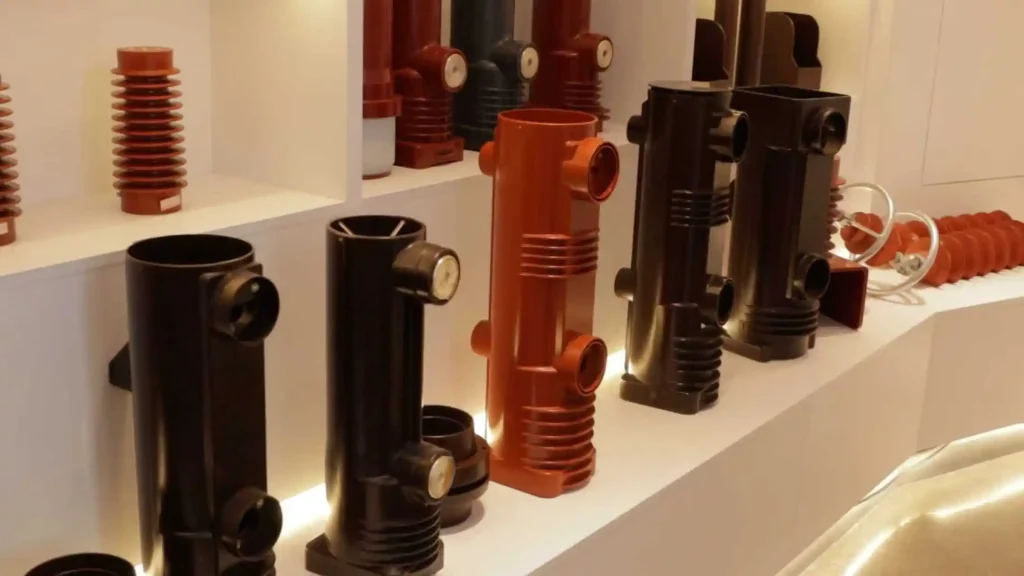
Are 200A, 600A, and 630A Separable Connectors Interchangeable?
In most projects, these three connector ratings are not directly interchangeable.
The difference is not limited to the amount of current that each connector can carry. The products may belong to different interface families and may connect to different bushings, inserts, junctions, busbars, or equipment sockets.
YIEOU’s 200A product range includes 15kV and 25kV loadbreak elbow connectors. The JY ZT-15/200, for example, is a fully shielded and insulated plug-in termination for connecting underground cable to equipment fitted with a compatible loadbreak bushing interface. It is rated at 200A and is designed around a loadbreak elbow structure.
YIEOU’s 600A range includes deadbreak T connectors, American-style T-shaped front connectors, 600A busbars, integral deadbreak bushings, mixed 600A/200A bushings, and insulated protective caps. These components form a higher-current deadbreak connection system rather than a direct enlargement of the 200A loadbreak elbow.
The 630A range includes European-style front and rear connectors. The front connector establishes the main connection between the cable and equipment, while the rear connector can be installed behind a front connector or another rear connector to extend the circuit.
Therefore, the first selection question should not be:
Which connector has the highest current rating?
It should be:
Which Separable Connector system matches the equipment interface and circuit design?
Only after confirming the interface should the rated current be compared with the expected operating load.
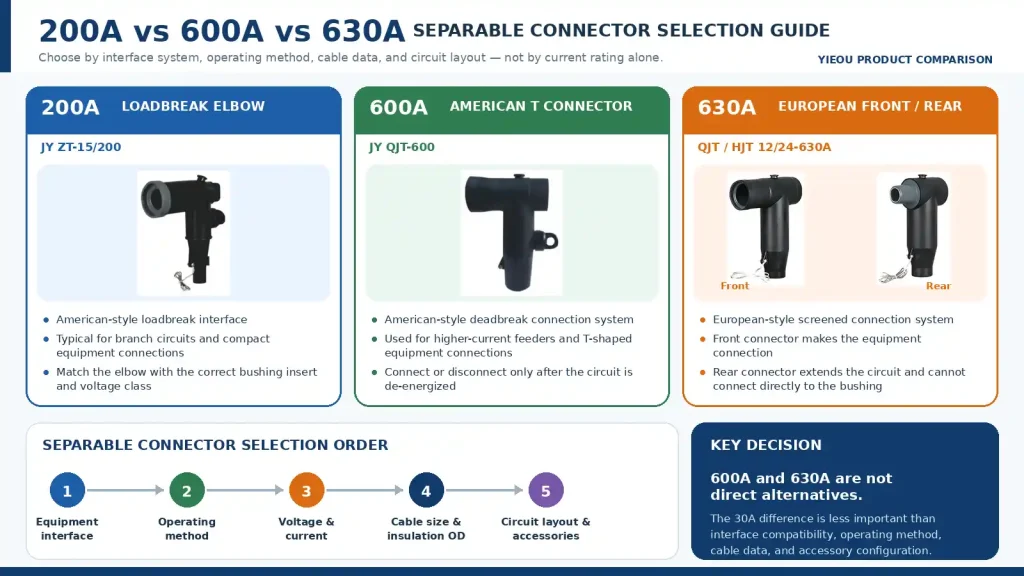
200A vs 600A vs 630A Separable Connector Comparison
The following table summarizes the main differences between the three systems.
Table 1: Main Differences Between 200A, 600A, and 630A Separable Connectors
| 选择点 | 200A Separable Connector | 600A Separable Connector | 630A Separable Connector |
| Typical YIEOU product | 负荷隔离开关肘型连接器 | Deadbreak T connector or T-shaped front connector | European front or rear connector |
| Typical interface family | American-style loadbreak system | American-style deadbreak system | European-style screened system |
| Common operating method | Loadbreak operation where the complete matched system permits it | Connection or disconnection while de-energized | Deadbreak front/rear connection arrangement |
| Main equipment connection | Loadbreak bushing insert or compatible junction | 600A bushing, busbar, extender, or matched deadbreak interface | Compatible European bushing socket and front connector |
| Common circuit role | Branch circuit, transformer connection, sectionalizing point | Main feeder, higher-current circuit, T connection, or separable splice | Main equipment connection with optional rear expansion |
| Expansion method | Multi-way junctions and matched 200A accessories | 600A busbars, T connectors, and mixed 600A/200A components | Rear connector, insulating plug, or rear-connected arrester |
| Important selection priority | Loadbreak interface and operating duty | Deadbreak interface and circuit current | Front/rear position and European interface compatibility |
| Can it directly replace the other ratings? | Normally no | Normally no | Normally no |
The table shows why a comparison based only on 200A, 600A, and 630A can be misleading.
The 30A difference between 600A and 630A is usually less important than the difference between their interface structures. A 630A European connector cannot normally be installed on a 600A American-style apparatus interface merely because the current ratings are close.
Similarly, a 600A deadbreak connector should not be selected for a 200A loadbreak interface simply to provide additional current margin. The equipment bushing, connector geometry, contact arrangement, and operating method must all be compatible.
When Is a 200A Separable Connector Suitable?
啊 200A 可分离连接器 is commonly selected for a medium-voltage branch circuit or equipment connection that uses a compatible loadbreak bushing interface.
YIEOU offers the JY ZT-15/200 for 15kV applications and the JY ZT-25/200A for 25kV applications. Both products use a loadbreak elbow configuration, but they belong to different voltage classes and must be matched to the appropriate cable and equipment interface.
The 15kV JY ZT-15/200 is designed as a fully shielded and insulated plug-in termination. It can be used with pad-mounted transformers, cable branch boxes, ring main units, switchgear, and other distribution equipment fitted with the required loadbreak interface.
A 200A system may be appropriate when:
- The equipment is fitted with a compatible 200A loadbreak bushing or insert.
- The expected continuous circuit current remains within the connector rating.
- The project requires an elbow-style cable termination.
- The circuit arrangement uses 200A junctions or branch interfaces.
- The operating plan requires loadbreak functionality supported by the complete matched system.
- Compact cable routing is important around a transformer or cable branch box.
The phrase loadbreak connector must be interpreted carefully. The connector, probe, bushing insert, equipment rating, installation condition, and operating procedure all need to support the intended switching duty. A loadbreak elbow should not be treated as permission to disconnect any energized cable connection without following the approved system procedure.
A complete 200A connection point may require more than the elbow connector itself. Depending on the equipment, the configuration may include a bushing insert, casing seat, multi-way loadbreak junction, grounding elbow, insulating cap, or elbow surge arrester.
YIEOU’s American cable accessory range includes these related 200A components, allowing the connector to be matched with the required equipment-side and circuit-side accessories rather than selected as an isolated part.
For ordering, the rated voltage must also be checked separately from the current rating. A 15kV 200A elbow and a 25kV 200A elbow share the same current class, but they do not have the same insulation level or interface requirements.
When Should a 600A Deadbreak Separable Connector Be Used?
600A 可分离连接器 is normally considered when the circuit requires a higher continuous current and the equipment uses a compatible 600A deadbreak interface.
The important term here is deadbreak.
Unlike a loadbreak elbow system, a deadbreak connector is intended to be connected or disconnected only after the circuit has been properly isolated, de-energized, tested, and grounded according to the project’s operating procedure.
YIEOU’s JY TTL-15kV/24kV 600A Deadbreak T Connector is used within a 600A separable connection arrangement. Its T-shaped structure can support connections between compatible 600A deadbreak components and may also be used with related extensions or separable splice arrangements.
A 600A configuration may be suitable when:
- The normal operating current exceeds the practical range of a 200A circuit.
- The switchgear, transformer, or cable branch box uses a 600A apparatus interface.
- A main feeder or high-current incoming or outgoing circuit is being connected.
- T-shaped cable routing is required.
- The connection will only be operated while de-energized.
- The system requires 600A busbars, bushings, protective caps, or mixed-current interfaces.
- The equipment layout needs additional distance for cable training.
The 600A category should be considered as a complete connection family. YIEOU’s corresponding range includes 600A busbars, integral deadbreak bushings, insulated protective caps, T connectors, and T-shaped front connectors.
This product-family approach becomes important when one piece of equipment has both main feeder and branch-circuit connections.
For example, YIEOU lists a 600A/200A integral deadbreak bushing as well as mixed 600A and 200A busbar arrangements. These products can support equipment layouts in which a higher-current main circuit and lower-current branch connections must be coordinated within the same distribution assembly.
However, the availability of mixed components does not mean that any 200A connector can be connected directly to any 600A component. The exact interface, product combination, voltage class, and equipment drawing still need to be confirmed.
When Is a 630A European Separable Connector More Suitable?
A 630A 可分离连接器 is commonly used when the transformer, switchgear, ring main unit, or cable branch box is designed around a compatible European-style screened interface.
YIEOU’s QJT 12/24-630A European Style Front Connector provides the main connection between an insulated cable and equipment such as transformers, switchgear, and branch boxes. It is suitable for indoor or outdoor installation and is specified for systems up to 24kV with a continuous rated current of 630A.
The front connector can be matched to copper or aluminum cable conductors and polymer-insulated cables. For the QJT range shown by YIEOU, the listed conductor range is 25–500mm² for 12kV cable and 25–400mm² for 24kV cable. The final model is selected according to both conductor cross-sectional area and cable insulation outer diameter.
A 630A European-style system may be suitable when:
- The equipment uses a compatible European bushing socket.
- The circuit requires a screened deadbreak connection.
- A front connector is needed for the primary cable-to-equipment connection.
- A rear connector is needed to add another cable branch.
- The circuit may later require a rear-connected surge arrester.
- The installation requires an insulating plug at the rear interface.
- Cable size and insulation diameter fall within the available model range.
One of the most important distinctions in this system is the difference between a front connector and a rear connector.
The front connector establishes the primary connection to the equipment interface. The rear connector does not replace it. YIEOU’s HJT 12/24-630A rear connector is designed to connect behind a European front connector or another compatible rear connector, creating an extended cable circuit or branch.
The rear position may then be closed with an insulating plug or extended with another rear connector or a rear-connected lightning arrester. The HJT rear connector cannot be connected directly to a bushing socket or wall bushing.
This distinction is essential when reviewing an equipment drawing. Selecting the correct current rating but ordering a rear connector for a position that requires a front connector will not produce a workable connection.
Is a 630A Connector Better Than a 600A Connector?
A 630A connector is not automatically better than a 600A connector.
Both can serve higher-current medium-voltage circuits, but they commonly belong to different connection systems. Their suitability depends on compatibility, not on which number is larger.
Table 2: Why 600A and 630A Are Not Direct Upgrades
| Common Question | Correct Selection Principle |
| Does 630A carry more current than 600A? | Its numerical rating is slightly higher, but this alone does not establish compatibility. |
| Can a 630A connector replace a 600A connector? | Normally not unless the equipment interface and complete accessory system are redesigned or confirmed as compatible. |
| Are both suitable for main feeders? | They can be, depending on the equipment design and operating current. |
| Is one always safer? | Safety depends on correct matching, installation, grounding, sealing, and operation. |
| Which should be ordered? | Select the system specified by the equipment bushing, voltage class, cable data, and circuit drawing. |
Choosing a connector with a higher current rating does not correct an interface mismatch.
A connector that physically does not fit the equipment, does not match the contact system, or does not provide the required insulation coordination cannot be made suitable simply by having additional current capacity.
The same principle applies to voltage rating. A connector rated for a higher current but the wrong voltage class, cable diameter, or equipment interface is not an acceptable substitute.
Which Details Determine the Correct Separable Connector?
A reliable selection process should follow a practical sequence.
First, confirm the equipment interface. Determine whether the transformer, switchgear, ring main unit, or branch box uses a 200A loadbreak interface, a 600A deadbreak interface, or a European-style interface.
Second, confirm the operating method. Establish whether the connection must support an approved loadbreak operation or whether it will only be connected and disconnected while de-energized.
Third, confirm the electrical ratings. The system voltage, maximum operating voltage, continuous load current, fault level, and insulation requirements must be considered together.
Fourth, confirm the cable construction. Conductor material, conductor cross-sectional area, insulation type, insulation outer diameter, shielding structure, and cable arrangement affect the connector model and accessory kit.
Fifth, confirm the circuit layout. Identify whether the position is a single cable termination, T connection, multi-way junction, front connection, rear extension, main feeder, or branch circuit.
Sixth, confirm the auxiliary components. The design may require a protective cap, grounding component, test point, surge arrester, busbar, bushing insert, or additional rear connector.
Table 3: Information Required Before Ordering a Separable Connector
| Required Information | 为何重要 |
| System voltage and maximum operating voltage | Determines the connector voltage class and insulation level |
| Continuous operating current | Helps determine whether 200A, 600A, or 630A is suitable |
| Equipment type and model | Identifies the likely connection arrangement |
| Bushing or interface drawing | Confirms mechanical and electrical compatibility |
| 负载断开或失电断开要求 | Determines the permitted operating method |
| Cable conductor material | Confirms suitability for copper or aluminum conductors |
| 电缆截面积 | Determines the conductor connection size |
| Cable insulation outer diameter | Determines the connector body or sizing code |
| Number of incoming and outgoing cables | Determines whether branches, busbars, or junctions are needed |
| Front or rear connector position | Prevents incorrect ordering in European-style systems |
| 浪涌保护要求 | Determines whether an elbow or rear-connected arrester is needed |
| Installation space and cable direction | Affects connector arrangement and cable bending |
| Indoor or outdoor environment | Affects sealing and environmental requirements |
| Project drawings and quantity | Allows the complete accessory configuration to be checked |
A cable cross-sectional area alone is not always sufficient for model selection. Two cables with the same conductor size may have different insulation diameters because of their voltage class, insulation design, manufacturer, or construction standard.
For this reason, the cable insulation outer diameter should be provided whenever available.
How Does the Equipment Layout Affect Selection?
The connector must fit not only the electrical system but also the physical arrangement inside the equipment.
A pad-mounted transformer may have limited depth between the bushing interface and enclosure door. An RMU cable compartment may impose strict limits on connector height, rear extension depth, and cable bending radius. A cable branch box may require several circuits to be arranged without interference between connectors.
A 200A elbow can provide relatively compact cable routing, but it still requires adequate operating and pulling space.
A 600A T connector may require more depth around the equipment interface, particularly when an extender, busbar, or additional component is installed.
A 630A front-and-rear connector arrangement can increase circuit flexibility, but every added rear component increases the overall installation depth. This should be considered before adding another cable branch or rear-connected arrester.
The number of Separable Connectors is therefore not the only dimensional issue. The complete assembly must be reviewed, including:
- Equipment bushing projection
- 连接器主体尺寸
- 电缆弯曲半径
- Phase-to-phase clearance
- Distance to the enclosure wall or door
- Space required for installation tools
- Additional depth created by rear connectors or arresters
When space is limited, a dimensional drawing is often more useful than a general product description.
Should Future Circuit Expansion Be Considered?
Future expansion can be considered, but it should be based on a defined electrical and mechanical plan rather than adding unnecessary interfaces.
A distribution project may initially use one incoming cable and one outgoing cable but later require an additional feeder, surge protection device, test position, or connection to another section of the network.
The appropriate expansion method depends on the connector family.
A 200A system may use a compatible multi-way loadbreak junction. A 600A system may use a T connector, busbar, or matched mixed-current component. A 630A European system may use a rear connector installed behind the front connector.
Unused interfaces must be correctly insulated, sealed, grounded, or protected with the specified cap or plug. They should not be left exposed simply because future expansion is possible.
The equipment compartment must also have enough space for the final arrangement. Adding another rear 连接器 may be electrically acceptable but physically impossible if the cable compartment does not provide sufficient depth.
How Can YIEOU Match the Complete Connector Configuration?
A medium-voltage cable connection often requires several coordinated components rather than one standalone 可分离连接器.
Depending on the selected system, the complete configuration may include:
- Elbow, T-shaped, front, or rear connector
- Equipment bushing or bushing insert
- 导体电缆接头
- Loadbreak probe or contact component
- Busbar or multi-way junction
- Insulating cap or plug
- Grounding accessory
- Test point component
- 浪涌保护器
- Installation consumables and instructions
YIEOU supplies American cable accessories, European cable accessories, 600A cable accessories, cable branch box components, surge arresters, and related medium-voltage products. Its product range includes 200A loadbreak components, 600A deadbreak components, and 630A European front-and-rear connection products.
This makes it possible to review the connector together with the equipment-side interface and related accessories.
For an accurate match, the most useful information is the system voltage, equipment interface drawing, cable conductor size, cable insulation diameter, circuit arrangement, installation environment, and required accessory positions. YIEOU also requests voltage levels, installation conditions, cable specifications, or drawings when assisting with accessory configuration.
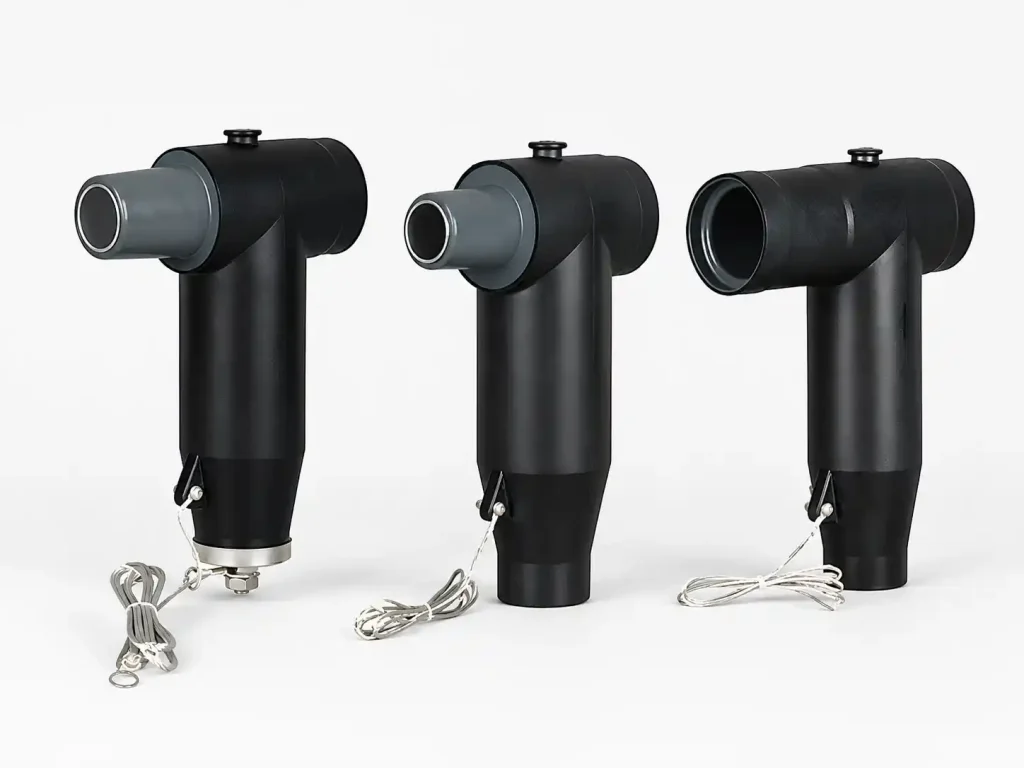
常见问题解答
Can a 600A Separable Connector replace a 200A connector?
Not directly in most cases. A 600A deadbreak connector normally uses a different apparatus interface and accessory system from a 200A loadbreak elbow. Replacing one with the other may require changes to the equipment bushing, cable arrangement, and complete connector configuration.
Is a 630A Separable Connector always European-style?
Not every product described as 630A worldwide necessarily follows the same structure. Within the YIEOU products discussed in this guide, the QJT front connector and HJT rear connector are European-style 630A products. The exact interface should still be confirmed from the equipment drawing.
Can a 630A rear connector connect directly to switchgear?
The YIEOU HJT 12/24-630A rear connector cannot connect directly to a bushing socket or wall bushing. It must be installed behind a compatible European front connector or another rear connector.
Is cable cross-sectional area enough to select the model?
No. The conductor area is important, but the cable insulation outer diameter, voltage class, conductor material, shielding construction, and equipment interface must also be checked.
Should the connector rating be higher than the normal load current?
The connector must have an appropriate continuous current rating for the circuit, but selecting a much higher rating does not solve interface or installation problems. Current capacity, voltage class, equipment compatibility, cable dimensions, and operating method must all be satisfied.
结论
Selecting the correct 可分离连接器 requires more than comparing the numbers 200A, 600A, and 630A. The following four points should be confirmed before ordering:
1.Confirm the equipment interface first.
Determine whether the transformer, switchgear, ring main unit, or cable branch box uses a 200A loadbreak interface, a 600A deadbreak interface, or a 630A European-style interface.
2.Match the connector to the operating method.
A 200A loadbreak elbow, a 600A deadbreak T connector, and a 630A European front or rear connector are designed for different connection and operating requirements.
3.Check the complete electrical and cable data.
System voltage, continuous current, cable conductor size, insulation outer diameter, conductor material, and installation environment all affect the final model.
4.Review the complete circuit arrangement.
Confirm whether the project requires a front connector, rear connector, busbar, junction, insulating cap, grounding accessory, or surge arrester.
A 630A connector is not automatically a better replacement for a 600A connector, and a 600A connector is not simply a larger version of a 200A connector. Correct interface matching is more important than choosing the highest current rating.
You are welcome to send YIEOU your equipment interface drawing, cable specifications, voltage level, and circuit layout. Contact us to confirm the suitable Separable Connector and related medium-voltage cable accessories for your project.