Product Overview
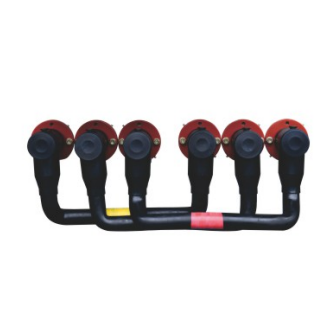
Lifting Cabinet Bus Coupler is a fully insulated, separable busbar connection component designed specifically for elevated switchgear cabinets (PT cabinets / metering cabinets / sectionalizing cabinets). It is manufactured using ethylene propylene diene monomer (EPDM) rubber integral injection molding with built-in conductive connecting bars. The component features full insulation, full sealing, and touchsafe characteristics, enabling busbar interconnection between elevated cabinets and other power distribution equipment. It replaces traditional bare copper busbar connections to enhance the safety and reliability of power distribution systems.
Core Features
Electrical and Insulation Performance
Constructed with high-quality EPDM rubber insulation and a built-in semi-conductive shielding structure to provide uniform electric field distribution, eliminate partial discharge risk, and accommodate system voltage levels from 10 kV to 35 kV.
Built-in high-conductivity copper bar conductors provide low contact resistance and high current-carrying capacity, meeting transmission requirements for various current ratings including 630 A and 1250 A.
Fully sealed construction with IP67 ingress protection effectively prevents moisture, dust, and oil contamination, ensuring stable connections in harsh environments such as high-humidity and high-dust conditions.
Installation and Compatibility
Equipped with standard interfaces compatible with European-style ring main units, allowing direct plug-in connection to busbar interfaces of elevated cabinets and ring main units. Installation is straightforward, requiring no on-site welding or casting.
Modular design allows flexible customization of length and interface quantity based on inter-cabinet spacing and circuit count, accommodating the interconnection requirements of various switchgear assemblies.
Fully insulated construction ensures the surface is at ground potential after installation, with no exposed live parts, eliminating the need for additional insulation protection and ensuring the safety of operations and maintenance personnel.
Environmental and Weather Resistance
Excellent weatherability for operation across a wide temperature range of -40°C to +90°C, with no degradation of rubber elasticity or insulation performance at extreme temperatures, and no risk of cracking, embrittlement, or deformation.
Anti-aging, UV-resistant, and ozone-resistant with a service life exceeding 20 years. Maintenance-free operation reduces long-term operational and maintenance costs.
Chemically resistant and suitable for harsh environments including high humidity, heavy dust, salt spray, and mild acid/alkali conditions, with no risk of corrosion or degradation. Applicable to industrial and mining facilities, coastal regions, and similar installations.
Typical Application Scenarios
Elevated Cabinet (PT Cabinet) to Ring Main Unit Interconnection: Achieves electrical busbar connection between voltage transformer cabinets and other ring main units, providing a stable busbar channel for voltage measurement and metering circuits.
Sectionalizing Cabinet / Bus Tie Cabinet Busbar Connection: Used for busbar interconnection between sectionalizing cabinets and other cabinet types within a distribution system, enabling sectional power supply and bus tie switching.
Internal Inter-Cabinet Connection in Compact Substations: Busbar interconnection between elevated cabinets and outgoing feeder cabinets within compact substations, compatible with both indoor and outdoor compact substation operating environments.
Industrial and Mining Enterprise Distribution Systems: Inter-cabinet busbar connection in humid, dusty, and corrosive environments, replacing traditional bare copper busbars to reduce short-circuit and electric shock hazards.
Technical Parameters (Based on 10 kV / 630 A)
| Parameter Category | Item | Technical Specification |
| Electrical Parameters | Applicable System Voltage | 10 kV AC (compatible with 20 kV / 35 kV) |
| | Rated Current | 630 A (customizable to 1250 A and other ratings) | |
| | Power Frequency Withstand Voltage (5 min) | 42 kV, no breakdown | |
| | Lightning Impulse Withstand Voltage (peak) | 95 kV, no breakdown | |
| | Contact Resistance | ≤10 μΩ | |
| | Partial Discharge Level | ≤5 pC (at 1.5 times rated voltage) | |
| Structural and Material Parameters | Main Body Material | Ethylene Propylene Diene Monomer (EPDM) + High-Conductivity Copper Bar |
| | Ingress Protection Rating | IP67 | |
| | Interface Type | Standard European-Style Ring Main Unit Interface | |
| Environmental Parameters | Applicable Altitude | ≤2000 m (high-altitude versions available on request) |
| | Ambient Temperature | -40°C to +90°C (operating), -40°C to +70°C (storage) | |
| | Relative Humidity | ≤100% (non-condensing) | |
| Applicable Standards | GB/T 12706, IEC 60840, GB/T 11022 |
Installation and Maintenance Guidelines
Installation Guidelines
Before installation, inspect the busbar coupler for cracks, damage, and voids; verify that interfaces show no deformation or oxidation and that all accessories are present.
Clean the busbar interfaces inside the cabinet, remove oil and dust, apply silicone grease evenly, and ensure smooth plug-in operation and reliable contact.
Adjust the busbar coupler position according to inter-cabinet spacing to ensure interface alignment, then firmly insert the coupler into the cabinet interface until fully seated with no looseness.
After installation, verify the grounding connection to ensure reliable earthing of the coupler housing, achieving the touchsafe characteristic.
Maintenance Guidelines
Periodically inspect the busbar coupler for cracks, damage, discharge marks, and contamination buildup; verify that interface connections are secure with no looseness or misalignment.
Periodically test insulation resistance and contact resistance of the busbar coupler to confirm performance compliance and detect potential defects in a timely manner.
Clean the coupler surface to remove accumulated dust and contaminants; prevent oil and chemical substances from corroding the rubber housing.
Should any abnormality occur — including cracks, damage, discharge, or insulation resistance exceeding the permissible limit — the coupler must be replaced promptly. Operation with known defects is strictly prohibited.
Applicable Standards and Certifications
International Standard: IEC 60840 — Test Methods and Requirements for Power Cables with Extruded Insulation and Their Accessories for Rated Voltages above 30 kV (Um = 36 kV) up to 150 kV (Um = 170 kV)
National Standards: GB/T 12706 — Power Cables with Extruded Insulation and Their Accessories for Rated Voltages from 1 kV (Um = 1.2 kV) up to 35 kV (Um = 40.5 kV); GB/T 11022 — Common Specifications for High-Voltage Switchgear and Controlgear Standards
Products have passed type testing by the National Quality Supervision and Inspection Center for Wire and Cable, in compliance with national electric power industry standards.
Appendix: Product Dimensional Diagram